


The Incoterms® rules, developed and updated by the International Chamber of Commerce, are now a recognized standard in global trade. They are integrated into sales contracts worldwide and provide a clear framework of responsibilities between parties, proving essential for exporters, importers, freight forwarders, legal consultants, and insurers.
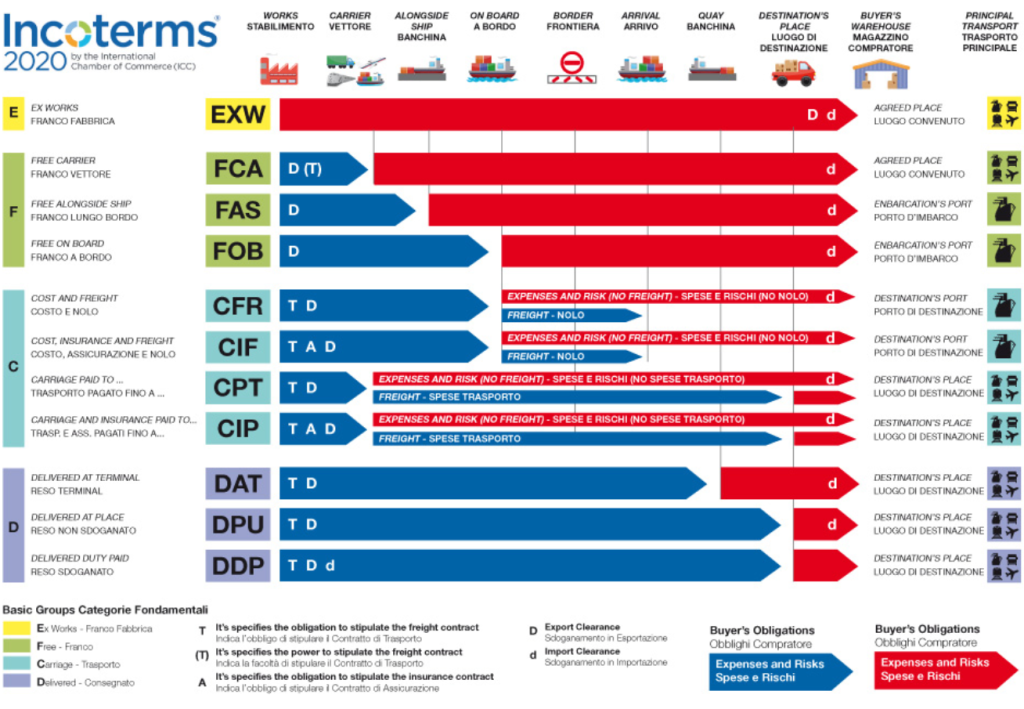
The seller makes the goods available at their premises, already packaged. All operations of collection, loading, export, main transport, import, and final delivery are the responsibility of the buyer, who assumes risks and costs from the moment the goods are collected. It is the most “unbalanced” delivery term in favor of the seller.
The seller delivers the goods to the carrier chosen by the buyer at the agreed location. From that point, risks and costs pass to the buyer. The seller handles the export, while the buyer manages the main transport and import. It is a very flexible rule and can be used in any mode of transport.
The seller places the goods alongside the ship at the port of shipment. From that moment, the buyer assumes all risks, including loading on board and sea transport. It is mainly used for bulk cargo or non-containerized goods. Valid only for sea transport.
The seller delivers by loading the goods onto the ship specified by the buyer. Once on board, risk and responsibility pass to the buyer, who manages sea transport and subsequent phases. It is suitable for traditional non-containerized traffic; FCA is preferred for containers. Valid only for sea transport.
The seller pays for sea transport to the port of arrival, but the risk transfers when the goods cross the ship’s rail at the port of departure. The buyer manages insurance (optional), unloading, and import. This term is used for traditional sea shipments. Risks and costs do not transfer at the same point.
Similar to CFR, but the seller must also provide minimum marine insurance for the buyer’s benefit. The risk passes at loading on board, while the seller pays the freight to the destination port. Suitable for non-containerized sea shipments. It remains a “hybrid” term: costs and risks are divided at two different points.
The seller pays for the main transport to the agreed place, but the risk transfers much earlier: when the goods are delivered to the first carrier. The buyer manages insurance (if desired), import procedures, and final delivery. It is a very common multimodal rule in modern international shipments.
Like CPT, but the seller must provide broader insurance, with coverage complying with IUA Clause A. The risk transfers to the first carrier, while transport and insurance costs remain the seller’s responsibility until the specified place of arrival. It is particularly suitable for valuable goods.
The seller delivers the goods to the agreed place, ready to be unloaded from the arriving vehicle. Risks and costs remain with the seller until that point. The buyer handles import clearance and tax procedures. It is a very practical term for international door-to-door deliveries.
The seller delivers and unloads the goods at the chosen destination. Risks and costs remain their responsibility until after unloading. The buyer takes care of import. It is the only Incoterms® rule that explicitly imposes unloading on the seller, useful when the customer requires “turnkey” delivery.
The seller bears practically everything: transport, export, main transport, import, and payment of duties, delivering the goods ready for unloading at the buyer’s premises. It is the term with the maximum responsibility load for the seller. The buyer only needs to receive the goods.